Thursday, 13 November 2014

THAILAND - Quiet Days in Bangkok (Marie - Français & English)

C'est notre 3e « escale » à Bangkok. Nous passons des journées très relaxantes ici. L'idée que nous avions de cette ville ne correspond pas du tout à ce que nous y avons vécu. Nous avons trouvé Bangkok assez agréable, assez propre et bien organisée, pas vraiment chaotique, frénétique et épuisante. Nous avons tous été très contents de notre hôtel, un Holiday Inn Express qui vient d'ouvrir il y a à peine 5 mois, avec du personnel très jeune et très souriant. Selon Éliane, nous y avons eu les meilleurs lits et oreillers depuis que nous sommes partis, et elle a probablement raison. Les filles ont «profité» du confort de l'hôtel pour faire des devoirs. Nous avons également tiré avantage de la salle d'exercice (surtout les 3 filles). À tous les midis, nous sommes allés manger du pad thaï à la même échoppe, tenue par une dame fort sympathique. Le pad thaï est un plat traditionnel thaï à base de pâtes très apprécié et très consommé dans toute la Thaïlande; son nom signifie littéralement « friture de style thaïlandais ». Donc, pad thaï aux crevettes pour Marie, au poulet pour Chloé, et végétarien pour Éliane et Carlos. Un pur délice! Quatre plats de pad thaï plus deux bouteilles d'eau pour un total d'environ 8$, c'est imbattable!

Pad Thai. Voici un example assez typique. This one has shrimps, but it could just as well have chicken, beef, pork or tofu. Also peanuts, chill powder, green onions, lots of onion, sprouts. There are many, many, many varieties of Pad Thai, we never ate two exactly the same. What they all have in common is fried noodles and a slice of lime. 
We had a few very relaxing days in Bangkok. The idea we had of this city did not correspond at all to what we have been living. We found the city quite nice, quite clean and well organized, not really chaotic, frantic and exhausting. We were all very pleased with our hotel, a Holiday Inn Express that just opened five months ago, with very young and cheerful staff. According to Eliane, we've had the best beds and pillows since we left, and she's probably right. The girls have "benefited" from the comfort of the hotel to do some homework. We also took advantage of the exercise room (especially the 3 girls). For every lunch, we've had pad thai in the same shop, run by a very nice lady. Pad Thai is a traditional Thai pasta dish, very popular and widely consumed throughout Thailand; its name literally means "fried Thai style". So Pad Thai with shrimps for Marie, with chicken for Chloé and vegetarian for Eliane and Carlos. A pure delight! Four pad Thai dishes plus two bottles of water for a total of about $8, is unbeatable!

Public transportation in Bangkok. River bus on the Chao Phraya river. 

Los monjes también toman el bote


Nous sommes allés visiter le Wat Pho, c'est-à-dire le temple du Bouddha couché, qui est l'un des plus grands et des plus anciens temples bouddhistes de Bangkok; nous avons adoré! Nous y sommes allés en transport en commun, d'abord en métro puis en bateau-bus, le tout très agréable.
We visited Wat Pho, that is to say, the temple of the Reclining Buddha, which is one of the largest and oldest Buddhist temples in Bangkok; we loved it! We went by public transport, first subway, then bus-boat, all very nice.

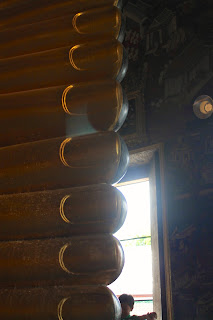
Le Bouddha en question


There are all sorts of paintings on the wall facing the  Buddha, not necessarily religious, but highly interesting. 
Ataque de elefantes

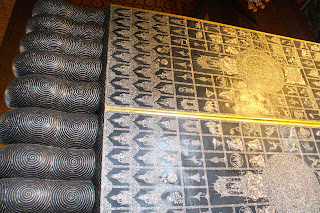
Funny detail: there are conventions on how to represent Buddha's toes, which of course are different from country to country


La planta del pié de Buda, con nacar, etc. 
Nous ne pensions passer qu'une heure ou deux sur le site mais en avons passer plutôt trois (au moins) tellement nous étions enchantés et pris par la beauté, la sérénité et l'humour qui se dégageaient de ce lieu.
We had expected to spend an hour or two at the site, but must have spent three hours (at least), so delighted and taken by the beauty, were we, the serenity and humour that emanated from that place.

Buddhist temples in the complex, with clear Chinese architectural influences


We loved this small monument (to stretching techniques???)


Saturday, 8 November 2014

SRI LANKA - Itinerary 2: Flowers and tea (Carlos - English & French)

Le jardin botanique à Kandy est une institution remarquable, commencée par les rois cingalais il y des siècles, et mise sur pied comme organisation moderne de recherche et scientifique par les anglais il y a 170 ans. Kandy, la capitale du dernier royaume indépendant cingalais (jusqu'en 1815), elle même est une ville qui sans doute fut charmante jadis, entourée de vertes collines, remplie de temples, dont celui qui contient toujours la relique la plus sacrée du pays, une dent de Boudha. Aujourd'hui, hélas, les rues étroites sont congestionnées par un trafic terrible jusqu'à 10 heures et ensuite de nouveau par la sortie des écoles, et encore par la sortie de bureaux.  

Un papa que le hace chas-chas a su hijita?...


Un palo borracho, gigantesco...


Cannonball tree...

Giant bamboo

There is a wonderful orchid house, a riot of colour, but subtle perfumes. Éliane was responsible for the pictures.

A giant insect?


We spent one day visiting the main tea-producing area (Nuwara Eliya, south of Kandy, higher in the mountains, cooler). We discovered that Sri Lanka produces only one type of tea, Ceylon tea. I don't know why it should have been a surprise, but it was. They classify it in several varieties. If you don't know the nomenclature, it can be unsettling, as people tell you quite naturally "I drink bio puffin"; methinks for a second "It must be difficult to procure in a tropical island". In fact they were telling me "I drink BOP fine", which along with BOP (Broken Orange Pekoe), OP and Pekoe, constitute the 4 main "grades" or quality of tea, although it all comes from the same plant. Ditto for black, green, silver (!) and white tea. Like coffee, or wine or whisky, tea has its own obscure jargon. I only remember that Pekoe comes from Peking.


Todos los tés de Ceylan son producidos a partir de una sola y misma plantita 


Saturday, 1 November 2014

SRI LANKA varia (Carlos)

Des photos prises au hasard des routes. Different pictures taken in Sri Lanka. Fotos diversas. 
Hedging your bets?... Seen in a tuk-tuk 
Éoliennes. Au Sri Lanka.
Crossing the road
At one point we went through a National Park on our way to Sigiriya. Many wild elephants still live there. 

We were driving on a road, and our guide suddenly stopped. We saw a man with a stick waving at us. This guy (about two meters long...) was teased out of his riverside nest with fish, for our private viewing pleasure. There is a whole group of them living quite close to people (there are people pretty much everywhere in Sri Lanka) 

Flor de loto
Quand il pleut, il pleut. 
There are a large number of artificial water reservoirs, built and maintained by the authorities centuries ago, some still used today. Sri Lanka gets a lot of rain during the Monsoon season, but it would not be able to sustain such a dense population without them
We refrained from talking politics, but it was pretty obvious that the Army had a very large presence in the country, following the Civil War. There will be national elections soon, and we saw a vast number of electoral publicity, and a truly prodigious number of posters and signs with the President (former General) doing this or that, usually accompanied by the local guy from his party. 
While the vast majority of Sri Lankans are Singhalese and Buddhist, there are minorities, of which the largest by far are Tamils, the majority of which are Hindu. Most live in the north, around Jaffna, but we saw many Hindu temples all over, as well as a fair number of churches, specially around Colombo. We saw this vast temple on our way to Anuradhapura from Colombo. We sensed no religious tension whatsoever, at least in the regions we visited. We asked our driver, and he told us it was fairly common for people of different religious backgrounds (less with Moslems) to get married, although often against the wishes of their parents. We learned that there is very little "dating" as we understand it, outside of Colombo.

SRI LANKA. Itinerary Part 1: temples, buddhism, ruins, rain - (Marie & Carlos, Français & English)

Au départ, le Sri Lanka ne figurait pas sur notre itinéraire. Comme notre vol de Kochi (Inde) à Bangkok (Thaïlande) comportait une escale à Colombo (Sri Lanka), notre agent de voyage nous suggéra de visiter également le Sri Lanka car cela n'ajoutait aucun frais à nos billets d'avion. Nous en avons donc discuté avec une collègue à moi qui avait été en poste au Sri Lanka et qui nous recommanda fortement de prendre au moins quelques jours pour visiter ce pays qui, selon elle, en valait vraiment la peine. Nous avons donc décidé de passer une semaine au Sri Lanka et avons élaboré notre itinéraire autour de cinq sites qui ont été désignés par l'UNESCO comme patrimoine mondial. Un autre collègue à moi, présentement en poste au Sri Lanka, me donna les coordonnées de notre chauffeur/guide, Amila, que des amis à lui avaient utilisé et qui avaient été très satisfaits de ses services. Voici donc notre itinéraire:

Initially, Sri Lanka was not on our itinerary. As our flight from Kochi (India) to Bangkok (Thailand) included a stop in Colombo (Sri Lanka), our travel agent suggested we also visit Sri Lanka because it did not add any fees to our tickets. We therefore discussed with a colleague of mine who was posted there; she strongly recommended that we take at least a few days to visit this country. We decided to spend a week in Sri Lanka and planned our route around five sites that have been designated by UNESCO as world heritage. Another colleague of mine, currently posted to Sri Lanka, gave me the details of our driver / guide, Amila that friends of his had hired, and were very satisfied by his services. Here is our itinerary: 

Jeudi 16 octobre: arrivée à Colombo à 10h55, nous avons passé la journée à l'aparthôtel Unique Towers (qui est superbe) pour que les filles puissent faire des devoirs. Carlos et moi sommes allés à un hypermarché à 3 minutes de l'hôtel pour acheter tout ce qu'il nous fallait pour dîner. Nous avions l'air de deux paysans qui débarquent en ville. Après l'Inde  l'hypermarché nous a paru gigantesque, super moderne, et ils ont de tout. En soirée, nous décidons de rester à l'hôtel où nous faisons venir de la pizza et des desserts, que nous dégustons en regardant un film de Batman (The Dark Knight).


Thursday, October 16th: arrival in Colombo at 10:55, we spent the day at the apart-hotel Unique Towers (which is awesome) for the girls to do homework. Carlos and I went to a supermarket 3 minutes from the hotel to buy everything we needed for lunch. We were like two country bumpkins come to town! After India, the hypermarket seemed gigantic, super modern, they have everything. In the evening, we decided to stay at the hotel, had pizza delivered, and watched a Batman movie (The Dark Knight). 

Vendredi 17 octobre: Amila vient nous chercher à 8h00, nous devons faire environ 5 heures de route (pour faire 210 km...; nous découvrons par la suite que c'est la vitesse normale à la campagne) et nous visitons la ville sainte d'Anuradhapura qui est l'ancienne et première capitale du Sri Lanka (elle fut capitale pendant 1300 ans). Il s'agit d'une visite magique; le site de l'ancienne cité est gigantesque et nous l'avons presque entièrement pour nous car il pleut. Nous sommes en pleine saison des pluies et la mousson bat son plein (jusqu'à maintenant, nous avons eu plusieurs heures de pluie tout les jours). Mais la pluie ne nous dérange pas, au contraire. Il fait si chaud et si humide que la pluie est la bienvenue. La visite sous la pluie ajoute une dimension mystérieuse et mystique aux ruines d'Anuradhapura qui sont dans la jungle. Je vous assure qu'ici, quand il pleut, c'est du sérieux; la mousson n'est pas une pluie comme on en connait chez nous: ce sont des torrents qui tombent du ciel!

Friday, October 17: Amila picked us up at 8:00 am, we must drive about 5 hours (210 km..., normal average speed, we discover thereafter) and we visit the holy city of Anuradhapura is the oldest and first capital of Sri Lanka (it was capital for 1,300 years). This is a magic visit; the site of the ancient city is huge and we almost entirely for us as it rains. We are in the rainy season and the monsoon in full swing (until now, we had several hours of rain every day). But the rain did not bother us, on the contrary. It is so hot and humid that the rain is welcome. The visit in the rain adds a mysterious and mystical to Anuradhapura ruins are in the jungle dimension. I assure you that here, when it rains, it is serious; Monsoon rain is not as we know from us: they are torrents falling from the sky!

First temple visited, where a beloved relic (Buddha's tooth) was kept for centuries
In this very sanctum of Sri Lankan buddhism, each temple has an image of some hindu god, to which buddhist pilgrims will also pray. Our guide told us that "You cannot ask anything of Buddha, but you can ask assistance of your favourite (hindu) god"... Very disconcerting for Westerners steeped in our exclusivist religious Weltanschauung of "Either-Or". BTW, you just don't see hindu gods in Thai or Mongolian buddhist temples (although you do see strong Chinese architectural and decorative influences).
Los amiguitos de Carlos... 
Rain at the first temple, which held for centuries Sri Lanka's most venerated relic, the Buddha's tooth, which then was moved to Polonnaruwa, and then to Kandy. Part of the reason these cities WERE the capitals. Of course, Sri Lankan official and popular (Singhalese) knowledge tend to underplay the rôle of Hindu/Indian power and culture, except to mention that the successive capitals were moved following troubles and invasions from S. India. What's significant about this city, is that its rulers in the 3rd century BC adopted Buddhism wholeheartedly, and with the Singha's assistance (buddhist order) unified and evangelized the country, turning it forever majority buddhist. 


You must always be barefoot and decently clad at a buddhist temple
One of the oldest pagodas (stupas) in Sri Lanka, around 2nd century BC. Originally they all had roofs (see the columns)
Temple entrance, with moonstone, guardian dwarfs and mythical animal 
Moonstone, a semi-circular stone, more or less elaborate, that stands in from of all buddhist temples. Here the four animals that represent the four stages of life (or illumination, not clear from our guide's explanations!). Later they eliminated the ox, probably as a concession to hindu (Tamil) power/inhabitants 
Combination mythical animal that guards the entrance of temples. Along with the traditional symmetrical dwarfs, these 3  elements around constitute the normal decoration of a buddhist temple (with religious significance, just like a Christian church's entrance) 


Evening prayers led by a monk, at Sri Maha Boodhi Temple 
The second most holy place in Sri Lanka. A beloved Bodhi tree, believed to have been propagated from the original Bodhi tree, under which Buddha meditated and was illuminated.
Hay muchas procesiones en templos budistas. Los fieles se visten de blanco, llevan ofrendas (flores, comida, bebidas), banderas y en general siguen a algunos músicos y a alguien (muchas veces un monje) que lidera las plegarias. Al llegar al templo o estupa, recitan sus plegarias (a Buda y a los dioses hindúes que estén presentes)
Devotees light candles. The lights flicker feebly in the night, through a slight incense fog
Samedi 18 octobre: Visite d'une autre ancienne capitale (bien que pour une très courte période), Sigiriya. La citadelle est construite au sommet d'un rocher de pierre rouge haut de 180 mètres, le «Rocher du Lion». Éliane et moi montons jusqu'en haut alors que Carlos et Chloé nous attendent un peu plus bas (ils abandonnent au pied de la dernière montée, très à pic). Il faut dire qu'il fait très chaud et humide, et ce bien que nous fassions l'ascension entre 9 et 10 heures du matin. Un autre site magnifique, éblouissant, nous sommes de nouveau charmés par ce pays.

Saturday, October 18: Visited another former capital (for a very short period), Sigiriya. The citadel was built atop a granite outcrop 180 meters high, the "Lion Rock". Eliane and I go up to the top while Carlos and Chloé wait for us slightly lower (they stop at the foot of the last climb, very steep). It must be said it is very hot and humid, although we climb between 9 and 10 am. Another great site, dazzling, we are charmed by this country, again.


Iguana peering out of an old thermite nest, by the road
Incredible defensive and civil works. Here, a tiny part of the enormous outer moat. 


Very colourful and interesting frescoes in a cave, half way up the rock. Sri Lankan guidebooks piously speak of some king's daughters or perhaps of women performing religious duties (this city always had a huge number of buddhist monks). I will let you decide whether this is a work apt to advance the religious path of monks.


The Lion Gate
Atop
Un Buddha visto desde arriba. Visitamos el templo un poco más tarde
 Dimanche 19 octobre: Visite de la seconde capitale du Sri Lanka, Polonnaruwa, qui fut la capitale du Sri Lanka du 10e au 13e siècle, après la chute d'Anuradhapura. Encore une fois, un site gigantesque et époustouflant, ainsi qu'une chaleur très humide.

Sunday, October 19: Visit of the second capital of Sri Lanka, Polonnaruwa, which was the capital from the 10th to 13th century, after the fall of Anuradhapura. Again, a huge, stunning site, and a very moist heat.
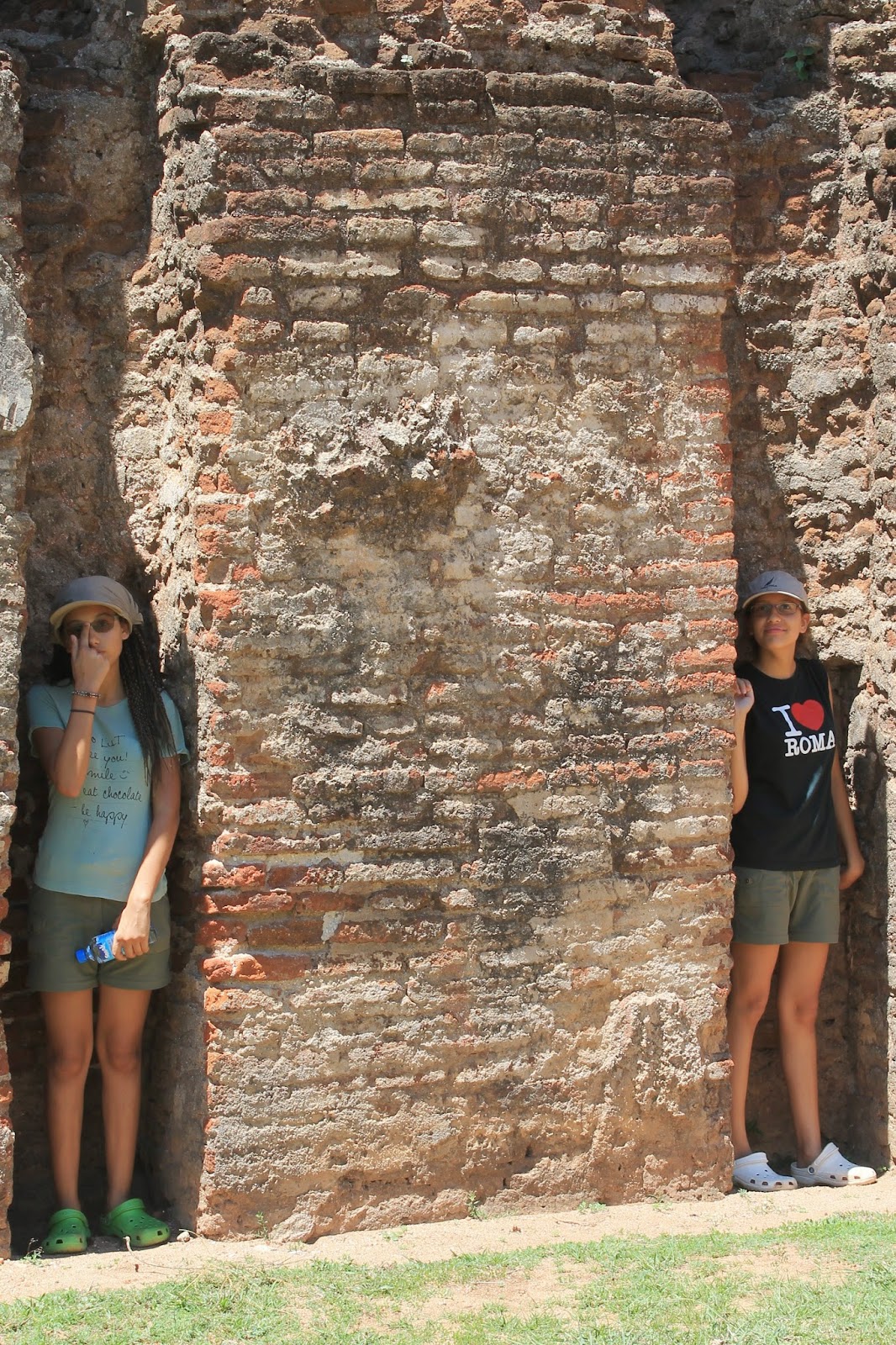
Believed to be a courtly building 


Nos encantó la serenidad de estos Buddhas meditando.


Otra stupa gigantesca
Finalement de la pluie!!!...


Sigiriya from afar. Note one of the numerous artificial lakes (amazing civil engineering, two thousand years old) built and maintained by royal decree. Many of these are still in use for drinking water today.
There were hundreds of different illuminated monks around the perimeter of this temple, all slightly different, but all in the same position, including this one. They look in, towards the massive standing Buddha statue
The Buddha statue we saw from Sigiriya


Les trois Bouddhas à Gal Vihara. sculptés dans le roc même. Très, très beau, et émouvant. 


To show respect, visitors are not supposed to take pictures with their backs towards Buddha


Ofrenda típica dejada delante de un estatua de Buda
Just like in Kipling's Jungle Book, many temples in ruins are inhabited mainly by families of monkeys